Category Archives: Inspiration

I am not my mother

My mom has been gone now for a few years and I know I had the best of her.

She was an experienced mom by the time I came along as child number four. I was born January 1965 to Dorothy Marie Stallman Traylor, a strong woman of German heritage. Her grandparents were immigrants, and the Dutch-American slang with a few German curse words still slipped from my grandma. Although mom did not speak German, she understood some. She understood more than that.

Born in 1925, mom never described her childhood as lacking although by most financial standards today, she would be considered poor. She had rickets from not drinking milk and ate a lot of homemade peanut butter. She still portrayed her life as an adventure.

My mom was a knock-out in the looks department and was adored by men and women in her town. She had black brown thick hair, dark brown eyes, and petite features of 36, 26, 38 (according to her). She was described by her friends around her as she was always smiling and accepting of everyone.

Post WWII, my mother and father married in a quick ceremony at a Catholic rectory in 1948. No she was not pregnant, but were in love. They had dated for 3 years on and off. Dad decided he could not bear to see her wed to anyone else. He realized he must be hopelessly in love with her. He did not like that feeling but gave in to it (his words not mine). She was a dependable hard-working wife. She cooked in a restaurant, pumped gas, sewed her own clothing, made meals in a pressure cooker and on a hot-plate, and lived in small rooms as a new wife. Her description to me was that she was happy because she was with him and it didn’t matter where they lived. She walked to work, she had two dresses, and made leftovers last several days. Wow. I am not my mother.

I only know the stories of all of the moves before I was born. Dad was back in the service, going from base to base, and still had money making ventures of building houses and selling cars on the side. At one point, he parked in Southern Indiana with our family for several years, built his own house, and we enjoyed friends and being closer to family. His dreams never let him feel fulfilled even though mom seemed at home where ever he took us. Dad loved to make profits and keep track of his gains and losses in journals. His plan was to retire a million dollars richer, and he spoke of these plans with mom while she cooked, cleaned, or read books. She smiled and nodded a lot and learned to pack a house up to move in a day if the Army required it. A flexible and talented soldier’s wife. I am not my mom.

The role of mom seemed to come natural to her, and she excelled at being a great homemaker. One homemaker skill of the fifties she proved time and time again was to make clothing and other things needed in the house. Sewing our pajamas, shirts, pants, and even a few suits, while bringing in some extra money sewing logo patches on hats for a local company. She spent 4 hours a day sewing typically during the fall before Christmas. She sometimes made her own patterns from store bought, adding paper, adding marks, and tailoring them for our short family. She fashioned car seats, ottoman covers, protective covers for dad’s recliners, drapes for the house, and repaired a lot of things dad asked for. Her patience for ripping out seams and doing over to make it perfect surpassed my abilities in every way. I most definitely am not my mom.

I never met such an accomplished listener as Dorothy Traylor. Her ability to listen and make a face or just ‘uh-huh’ noise was sometimes all her kids or grandkids needed to understand her. Endlessly empathetic but firm when you were screwing up, she never failed at making us want to please her by trying to make her proud. Her face was easy to read for most people who knew her. Although I rarely saw her mad or really angry, if she was, that face showed it. The lips tightly pressed and eyes narrowed with head slightly tilted down, and if she was really mad, her eyes looked out above her glasses rim and her closed fists propped on each hip. Then the index finger. If one fist left its tidy perch upon the hip and formed into a pointed warning to your nose, you knew a spanking was near if you didn’t “straighten the hell up”. She rarely cursed except behind dad’s back when she was real mad and stuck her tongue out at him and whispered “ass” as she walked into the other room. My mouth was not as civil as a young wife and mother. I am not my mom.

She imparted a role of the hostess and keeper of the house by never turning away anyone who showed up by invitation or not to sit at our table for a meal. She had supper on the table at 5 pm every day, for all 53 years of their marriage unless she was in the hospital. Friends of her kids, grandkids, her husband, neighbors, all could count on a plate of food if they showed up at regular meal time. My friends called her mom Traylor as did many people who came in the door. She never demanded good manners, or denied anyone if they smelled, or if they had no appreciation.

Now as my daughter becomes a mother and I slip into the role of grandmother, I think a lot about my mom. She would know how to do this better. I hear her voice telling me these things over the years but as a speech. “You are not me. Don’t try to be me because I was not perfect. Remember what I taught you – treat others how you want to be treated. Stop trying to be something else and just be who you are. You can’t teach them everything but how you respond to their mistakes you can control.” I see her looking out over her glasses with head tilted down.

I can’t be my mom. She was a mom in the 50s.

She lived through the depression, WW II and more challenges than I will ever face as a woman. She had no conveniences as a kid and started making her own clothing at 15 so she could express some of her individuality and have nice things. She worked physically very hard by working, studying, and then she played hard with friends. My mom was taught that she should strive to be a good wife and mother over anything else. Though she achieved that goal and more, she also raised me to know I can be whatever I want to be. She taught me how to take care of myself and others.

When I said I wanted to be a firefighter when I was seven, she smiled and just said, “that sounds like something you could do but why do you want to do that job?” She let me look at myself as more than a girl. That was forward-thinking in her time. Because she didn’t raise me just like her mother had raised her, I became my own woman.

After I gave birth to my daughter, I was crying over the phone to mom on my first day at home alone with my newborn. I said, “I don’t know how to do this!” She said, “There is no instruction manual for parenting. You will figure it out as you go like everyone else. When you make a mistake, say you are sorry and you love them and move on. Love her and take it a day at a time. You will be fine. You can do this, I know you.” I believed her.

Sara cannot be me because I was a parent in the 90s. I am not my mom, and my daughter is not me. There is no instruction manual.

Leave a comment

Filed under Aging, Inspiration, Motherhood

Waking up…

Physically waking up is a major triumph when you know 3 of the 6 names in the obituaries every day. Just getting from breathing to dressed in the morning is a wide gap faced with reapplying makeup after sweating it off during a dozen hot flashes in the first hour.

Waking up when you are 20, 30, 40, and 50 are so very different. I really don’t remember 20 so I can’t say I miss it. I do remember at 30 jumping out of bed because my day was full with a kid, a job, a husband, a life.

Forty, the wake up was more of a slide into the needed activities of the day, followed by grumbling and self-loathing after a long day.

Fifty waking up having hurt myself during the short sleep has been usual. I feel like I have done this before I tell myself. Repeated gestures lead me to forget where I am in the process of waking up. Did I turn off the light in the bathroom? Did I remember to turn off the coffee pot? Where’s my work badge? Waking up now takes half the day and starts over at 1 pm when the energy drops and a nap is needed. Work is a state of being that holds some pride but obviously I would not do it if I was financially able to stay home in pajamas.

Waking up to aging happened when I looked in the mirror and decided make up was not needed because it wasn’t going to get better. Who was I trying to impress and did I really give a shit? No, so no more make-up or hairspray. No acrylic fingernails or long hours at the hairdressers paying for hair color. Embrace the grey. No more trips to the store for menstrual pads or cramps medicine. Menopause has a few perks.

Waking up in relationships happened before I married for the third and last time. When I basically decided I didn’t really want a man again, I found a good one. He accepted me and I him just as we were. Some days we are great, kind, thoughtful, and others we are just assholes. But that is okay.

Waking up to your sense of self is the best part of aging over 55. I know who I am and have no big career goals to meet. I am looking forward to grandkids and retirement as I get closer to my 60s. I accept myself with flaws and wrinkles. I have no illusions that I will beat death or become well known in my lifetime by anyone other than family and friends. I don’t expect to be perfectly happy everyday and that is okay. My biggest plan for tomorrow is to…wake up.

Leave a comment

Filed under Aging, Faith, Inspiration, The Past

Getting Older and passing through my story.

The older I get, the more I find myself contemplating things. Life, people, the whys and whats of living and finding purpose. As years drip away, it seems easier to leave material things behind because I know I don’t need it where I am going in the future. I have been reading a few books lately about Near Death Experiences (NDE) because I find them a wunder. A miracle that such traumatically hurt people awaken and recovery quickly and bring with them such common stories from young to old NDErs.

I have always had lots of doubts because I want to understand things, how things could possibly work. The human body is a wunder as well, and we still don’t know all of the ways the brain and neurological system heals itself. Just because I don’t think there is a way to know it all and that is how it is suppose to be, does not mean I don’t want to seek those answers. God makes us seekers of truth and knowledge, his inquisitive children. We are never really satisfied in our life on earth and always looking for satisfaction in some way. Probably because we are wired to seek something in Heaven and we are looking for it on Earth. What has kept me up nights is a fear of losing myself and all I know, my family, my friends, my memories, who I was when I leave this world. Reading this book has given me a sense of peace with that annoying worry and driven it away.

I feel assured and more confident that my life force will pass into a different dimension of Heaven some day where there is no fear, no pain, no time, and all the people I love will be there enjoying the same spiritual dimension. I will not be the same in body, but my thoughts, my true self will evolve into a full meaning and full complete self when my spirit is set free from the limitations of my body.

I find solace in the fact that NDEers have come back to say that they immediately knew answers to anything they wanted in Heaven and felt fully aware of a full communication with a loving God and reunion with all loved ones who were happy and present. They were told all answers would come to them after their second return since they were being sent back. Most did not want to go from that wonderful place of peace and happiness. However, they knew they had to return to share what they found and who they met.

In this Easter Season, even as a doubter, let’s agree that it is a year of birth and death.

The cold and rot of winter is breaking to allow a rich fertile harvest to begin. Allow some seeds to be sown of new beginnings. If you are not a Christian, know you are loved and welcome to share in the grace of God at any time you accept.

For me, I am just a story waiting to be told.

Leave a comment

Filed under Aging, Faith

Grandma Rose

Grandma looked like a spider crab moving as she grasped chairs, knobs and doorways to pull her weight in the wheelchair.  I was seven and visiting her for a week during the summer months off of school.  I sat across from her at the kitchen table; her head drooped over a plate of dry cake soaked in warmed coffee.  Her hands were unsteady and as they shook, the crumbling cake fell onto the old china plate.  After her snack, we went into the living room and she pulled out an old photo album.  It was a normal routine for us to go through her life in pictures while I visited. I always had new questions for her since she enjoyed sharing.  Her dry leathered hands, scarred and crooked cupped each black page with tucked black and white pictures. 

She showed me a picture of her sisters Louise and Mary.  Mary had become a nun and her name was changed to Sister Benigna. She had to shed all things from her life when she became a nun in 1923.  She wore a black and white long dress and a similar hat covering her entire head accept her face.  Her face was round and pleasant but my grandmothers nose crinkled when she talked about her.

“She was favorite because she was called by God,” she would say in her Dutch German accent.  “But my sister Louise was favored because she married rich and got a pew in the front of the church.” She would drop her eyebrows as she looked at the picture of her sister and turn the page.  “I sat in the back with the others who have nothing.” Grandma would look sad until she looked up. 

I climbed into her lap from my stool and her soft lap comforted me as I hugged her tight. “But Grandma, I’ll sit with you!”  She closed the book and put it aside and said, “Yes, and that’s special.” She smelled of menthol, and lye soap but she always made me feel loved.

Sometimes our lives are full of tragedy, sorrow, struggle, and countless other small challenges that seem to overwhelm our thoughts.  When we recount our lives, it is easier to recall those things that really test our faith. 

In those times that you feel unimportant or overwhelmed, remember that God has already given you the greatest gift; the gift of unconditional love through the sacrifice of his son on the cross. 

Matthew 18:3 “ I tell you the truth, unless you change and become like little children, you will never enter the kingdom of heaven.  Therefore, whoever humbles himself like this child is the greatest in the kingdom of heaven.”

Leave a comment

Filed under Faith, Inspiration, The Past, Uncategorized

Advice to Young Writers

“You cannot hope to sweep someone else away by the force of your writing until it has been done to you.” Stephen King from On Writing

When students ask me for advice about writing for a living, I begin by asking them a question. “Do you write every day, even if you don’t have to?”

If the student responds yes, then I tell them, you are already a writer. No matter what I tell you, if you have a passion to write, you should try to improve your skills in every way possible and keep writing.

To be a good writer, you should practice all types of writing. This means excelling in writing for school and for enjoyment. Writing is not easy if you are doing it for a living. Like anything else at a professional level, it is hard work. But it does have it’s rewards if you love what you do. If you are disciplined enough to try and improve in writing you don’t necessarily enjoy, then you have the endurance to do even better at writing something you enjoy.

In order to write well, you should read just as much. In his book, On Writing, Stephen King states, “If you want to be a writer, you must do two things above all others: read a lot and write a lot. There’s no way around these two things that I’m aware of, no shortcut.” By reading a lot of classic books, the writer begins to see how plots are written differently. Elements such as setting, character, conflict, and themes emerge and help the reader understand the importance of incorporating the best samples of those elements in their writing style. These are lessons learned from middle school through college.

The next question I ask of a writing student who likes to write is: “Do you write because you want to be a famous writer someday?”

Many will respond, “yes”. It makes me wince because I once felt the same way. As I aged, I realized that less than one percent of writers make money writing books, and less than that actually achieve recognizable fame publishing books. Most will share that going through today’s publishing world has a lot of frustrations. I try to encourage the young writer by encouraging smaller more achievable goals that can increase their skills, experience a few setbacks, and pay some bills. There are many professions that give a great deal of experiences that can be used to create fascinating stories. While those skills are growing, I give the following advice about a career path in writing.

  1. Read as much as you write.
  2. Emulate styles of writing and genres you enjoy.
  3. Join writing groups outside of school.
  4. Join academic writing groups (journalism, newspaper, yearbook).
  5. Go to college and major in something that helps you manage your career (business, computer & graphic design, publishing, or contract law).
  6. Investigate professions that depend on good writers and aim for those.

I have told the student to read more, write more, and practice. The last basic advice next to practice all forms of writing is to write what makes you happy, and practice it daily. Practice how to cut, edit, rework, read, and rewrite your stuff again and again. Use criticism from others as a challenge to improve. If a piece of work still doesn’t seem right, put it in a drawer for a few days or weeks and write something else for a while. When your brain is ready to look at it again, start at the beginning and read it through without stopping. Mark spots you want to revisit, but do not make any notes that will stop the reading process. Never throw it away, but don’t be scared to shove it in a drawer. I have stories filed away I may never publish, but revisit once in a while that spawn other ideas for stories. Not everything you write is gold. In fact, you will write a lot of garbage if you write often. However, begin able to recognize and appreciate your garbage takes time. Writing well and analyzing texts are important skills for most practiced professions.

Most of the famous writers today are doctors, lawyers, politicians, teachers, or other financially secure professionals. Their education helps them meet people who can help their writing careers advance, and gives them a firm financial ability to fund some of their writing aspirations. Limiting your career to sitting and writing does not give you much life experience to write about. Traveling, meeting a lot of interesting people, and communicating with others who have had exciting experiences are invaluable to a writer’s notebook of ideas for writing.

There is no limit of written dreams on shelves from authors who never “made it”, and I try to explain to students of writing that it is a hard road if you write entirely to become famous. Instead, write because you like doing it. If you get paid for writing, that is just a happy bonus. There are always more words to write, but know when it’s time to say the end–until tomorrow.

Leave a comment

Filed under Inspiration, On Writing, Uncategorized

Sometimes I hear beauty

Looking around Brown County with a friend, the sky was clear and bright blue, the clouds looked like cotton balls, and bright colors and great weather was all around.

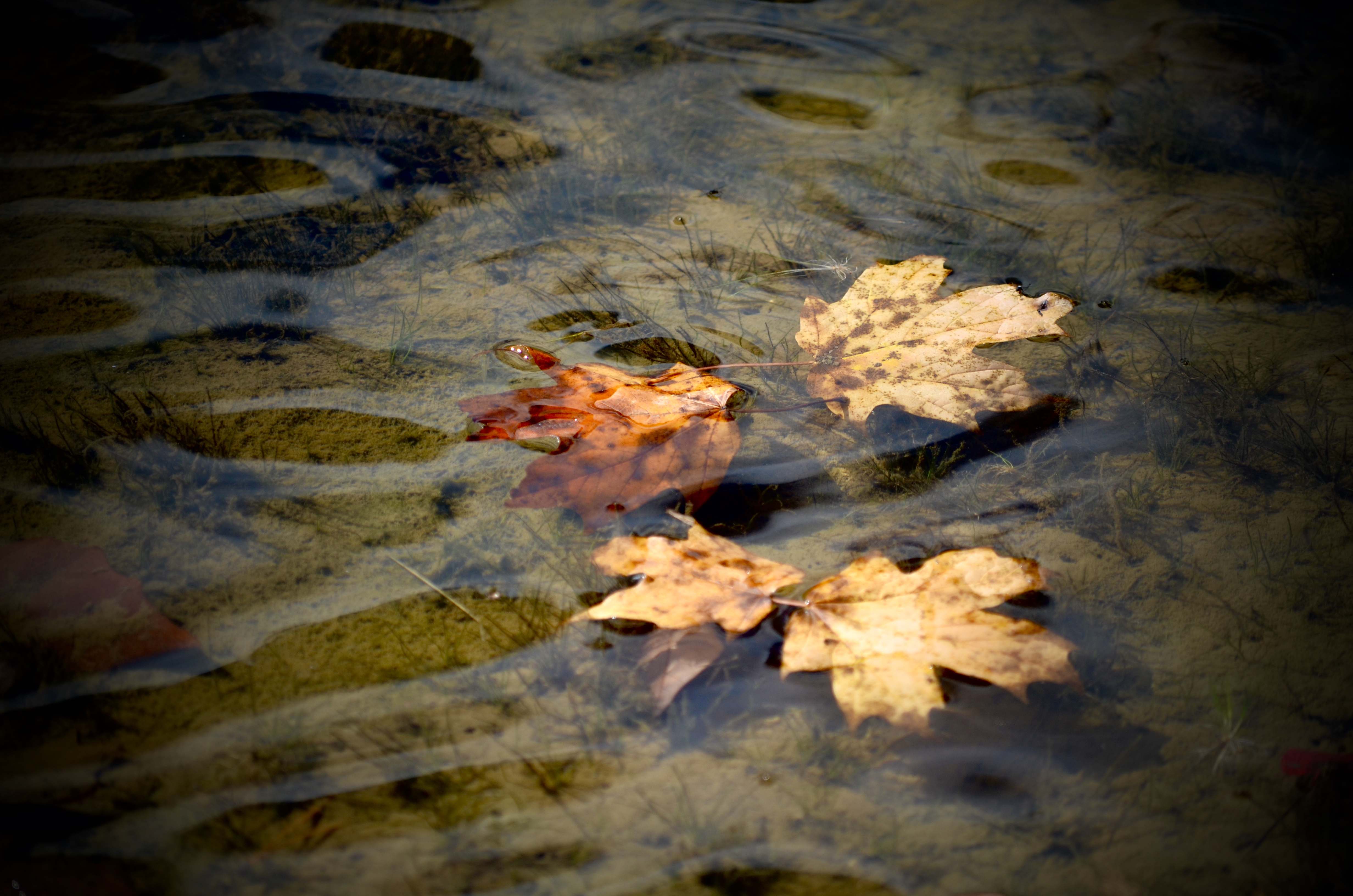
I look down and the water is muddy, some trash was floating from some previous fishermen. Then I watched as the wind blew the water into uneven swirls and all the leaves now falling were spinning and finding their fall in the beginning of a journey. The drying leaves, colors bright yellow and red, dunking deep then bouncing back up to the top of the water for a ride with waves against the muddy shore. Slowly, the water rested as it reached the edge of the grassy bank below my feet. Lap-plop, lap-plop, lap lap-plop. Moving a force of fallen yellows and reds, four leaves found each other in a slowing spin, dancing around as though attached in current force to one another. As their spin slowed to a paired waltz, their colors seemed to reflect a last burst of life and love, but a sense of a day in repast.

The beauty found me there, I took my picture, I closed my eyes, and heard the wind, and felt my breath. I saw the pairs float on down along the bank, still posing like a grand promenade onto the next port. A witness to beauty and perfect purpose in cycle, a dragonfly perched upon the two for a ride and stayed for a while. I closed my eyes and could still see the bright sun in the bouncing rays off the lake. I could still hear the wind, the buzzing of insects in living, leaves falling, and distant birds singing about their day.

Leave a comment

Filed under Inspiration, Photographs and Art

She was a prisoner on the inside and we were prisoners on the outside.

I want to talk about my mother by writing a book. I lost her recently and my way to deal with pain is to write. She was 94 and mortal, so I didn’t expect her to live forever. There is never enough time to do all the things or say all of the things you want to and death seems to focus that reality. Regret, guilt, anger, longing, only some of the feelings to bear with grief. But to write a book about it in a way that helps others channels the emotions into a positive light.

I write for many reasons. In this time of grief, I also want to help others. My mother was in a nursing home and during that time she contracted COVID-19 from a worker. It was difficult enough that they closed the facility to protect the residents two months prior, but then they actually carried it in to her and passed it through a lack of attention to infectious disease protocol. So, I had to start making notes to myself to decide what the purpose will be in writing this book.

I always begin with the same three questions:

Am I writing to entertain?

Am I writing to inspire?

Am I writing to educate?

If the purpose of my writing is an emotional or cathartic release, then it is a diary and is not likely to help or inspire others as much as to help me cope. Although a book can serve all three of the purposes listed, one usually stands out as the primary purpose. In my case, I feel that I need to educate by offering a map of transition from home to nursing home and help others understand what happens after those decisions are made. The next questions I ask relate to the expected outcome. I ask myself the following:

What outcome do I hope for the finished product and who might this book serve?

Is this book going to instruct someone on how to navigate a similar circumstance or problem?

Is this a platform for change?

Once I have answered all of these questions, I am able to identify the type of book I want to write. The next question is imperative to understanding my mindset at the time of the writing.

What essential question do I want answered or what is my strongest desire to fulfill in writing this book?

In order to really stay focused on writing, I have to be passionate about the cause or the purpose for writing. I try to stay on track and not go off on wild tangents that are fueled by anger or regret in a story, but ultimately it happens. That is why I edit later and do a lot of rewrites. But getting as much down as fast as possible is typically how I roll once my basic outline is set up and beside my computer.

I was a nurse for 30 years and have 15 of those in long term care. I understand the system from both sides. I understand the nurses mindset and how they cope with low staffing and not enough time in the day to do all that has to be done. I understand the endless charting to cover your butt from lawsuits and the state and federal laws related to long term care facilities. I was an administrative nurse acting as a DON at an assisted living facility for two years and met with state reviewers during annual reviews. As a family member with medical training, I witnessed poor care, substandard PPE use and lack of professionalism during care of my mother when I was visiting. I understand the feeling from the point of view of a family member with no control and limited information of how my mother was treated day to day. in my absence. I visited, helped with what I could, and walked away hoping they would care for her but knew it would not be with the same detailed care I could give.

That is how I begin. I am beginning a book about my mother. I will probably write two. One will be to help others to navigate the maze of long term health care for the aging, and the other will be about who mom was before she was seen as an old lady. Understanding the difference in these books and separating the two by purpose is important so the audience is not trying to navigate an unclear trip through a grieving brain of a motherless daughter.

Leave a comment

Filed under Aging, Inspiration, On Writing, Uncategorized

The Nursing Home Dilemma

You never want to face the day of placing a loved one into a long term care facility. It makes you feel like you are sentencing them to a slow and boring death. However, there is a time when you can do no more for them yourself, or your parent or loved one cannot care for themselves safely. That was what happened to my family as my mom entered her eighties.

At the age of eighty-eight, mom was no longer able to get around as well, and we were doing the outside work and maintenance to her ranch home. She was still doing what little shopping needed for food and clothing. She was still able to pay her bills and keep her checkbook, but it was time for a change. I was the one who suggested a senior community knowing things were changing.

There were four of us kids, spread out over twelve years of age from the oldest to the youngest. I was the youngest and my daughter and I had been sharing a home with mom for ten years. We had seen her through a hip replacement, a broken leg, and several hospitalizations for ailments. My daughter had left for college now, and I had met a man who would later become my husband. The opportunity had come to move to Texas with this man but it would mean leaving mom to be assisted by my family still in Indiana. Because of this move, mom thought it was time to sell the big house we lived in. She was a realist and that was a blessing. She looked at retirement communities and we agreed on a senior apartment complex with a shared dining and common areas. The move happened quickly and I was in Texas a month later.

It went well for her for three years with me in Texas and the rest of my family in Indiana. She had a small apartment but privacy and could come and go as she pleased. She began falling, and then she took too many of her medications in one day. She was hospitalized, and later found to have a failing heart and kidney failure. She needed heart surgery at 91 years old. It was a risk, but if not done, she would not live long. I came back to take care of her for three weeks after she came out of heart surgery like the strong woman she was.

Strong or not, she was getting older and an assisted living facility was the next big move to assure her medications were controlled and her finances were monitored by my sister since she had a habit of sending money to every cause that called on the phone. I went back to Texas for a year before moving back to Indiana for good. Mom’s vision was slipping away due to glaucoma and she was labeled as having mild Dementia related to age, heart, and kidney disease. She was forgetting what happened yesterday, the day before, and some of the months were running together. She had covered her forgetfulness for several years from what we saw on her finances and closets full of overbuying things she had already purchased only days before at a forgotten grocery store trip.

These were only a few of many signs of rapid decline in my mother’s ability to care for herself that we saw. She could still carry on a conversation, sounding as intelligent as she had always been and covering her forgetfulness blaming age and being tired. For the most part, it was working for her until her health decline made us aware of her ways of hiding things. On top of facing our changing roles between child and parent, we had to become the advocate for her minimum standard of care in the aging long term facility model in the United States.

Long term care should be labeled, “Death by discard”. It may sound harsh, but often elders are left in these homes for the old with few visits by family. It gave me an extreme amount of guilt and depression by committing her to live in a facility because I knew the visits from family would be few. By “few” I mean, once a week for an hour on Sunday afternoon with grandkids in tow kind of “hi Mom-love ya” visits.

I am not dismissing that I did the same type of quick visits while living my life, working, paying bills, and caring for my kids. It’s easy to forget to call mom every day and to make a point to stop in every couple of days just to check up on her. Soon I started to see healthcare from a different perspective. I had lived as a nurse for 30 years with 16 being in long term care. I made excuses of knowing how understaffed facilities were and that it would not change. I tried to take on some of the burden of meeting mom’s needs until I saw an ever narrowing gap between a minimum standard of care teetering on the precipice of neglect. I knew what should be done, what was not being done, and recognized lack of training and care when I saw it because in my day in a facility I was one of those tyrannical nurses that CNAs hated working with. I was demanding to make sure residents received above standard care. I dealt with a lot of families but none ever accused me of not caring for my patients.

I was still hesitant in becoming “that daughter or son” in my mom’s facility. The one was the kid I dreaded dealing with when I was working long term care. The one who came in once a week and thought she knew everything that should be done and how. The one that complains all the time and doesn’t see mom’s confused days and bad days and is on her best behavior on the days of a visit. I get it.

I did become the one. I saw dirty toilets, unchanged linens, trash overflowing, and lack of staff. I heard excuses of trying to meet the needs of so many with so few. I was the one who was not notified when mom fell and I saw her three days later with massive bruising on her right side with dried bandaids over a skin tear which would retear when the bandaid was finally changed. I was the one who worried at night in my bed if she was falling or messing her bed with no one to help because the night shift was short. My parent had become as much a worry for me as I was for her when roles were reversed and I was the sick child in the care of someone else.

As we have moved into the future, my mom is 94 and now in Hospice care. The last three weeks feels more like a year with mismanaged care, agency nurses covering a failing assisted living facility and Covid 19 infection outbreak that has pushed my mom’s health over the precipice. She regains to a coherent state for minutes a day instead of hours, overshadowed by confusion, fear, and a moaning ache of age and discomfort as her days dwindle. My role as her advocate for respectful care has become as a lion over a cub. While others dismiss that she has lived a good life, and some justify that she should be drugged to keep her stoic and safe, I continue to fight for her right to be monitored, respected, and loved for where she is in life and not push her off the cliff to make room for the next one.

This small shriveled woman sleeping her days away is the same woman who sat up nights holding washrags to her kids fevered heads. This is the woman who picks up the falling toddler. She is the woman who hangs sad silly pictures of nondescript animals on our refrigerator and always has a warm meal and seat for a stranger. She is the brunt of dad’s stupid jokes and our pranks. She is the patience blocking dad’s anger and our butts on a bad day. She is the magician who makes a meal for six stretch to eight when dad brings home guests. This is the healer who had endless bottles of mercurochrome and Bactine covered with bandaids. This is the gardener who canned enough food to last all winter from her hard tended garden. This is the dark figure sewing pajamas at 2 am the day before she made Christmas dinner for 35 people by herself. This is the chauffeur, PTA member, seamstress for school plays, church social participant, kleenex holder and carrier of the mom purse of wonders. Her very existence is my inheritance and making a caregiver see that vision of what she has been and what she is to us is hard when they view her now, shriveled up and quiet.

While you never want to face the dilemma of long term care and being a parent to a parent, it may come. If that day comes, never take a backseat. Be that one kid. Be your parents advocate for care and respect. As the roles change, know that you will be in her place some day and pray you will have the same grace of someone loving you so hard that they are the one.

If you are considering long term care for yourself or a loved one, check back on my blog next year. I am working on a book to help families transition and navigate this journey.

Leave a comment

Filed under Aging, Inspiration

Ideas for writing

I have never had a problem finding lots of story ideas. Writing stories started with my love of books in elementary school and going to the local library on Saturday morning. I loved stories of characters in an adventure like Curious George and Madeline. I wrote little stories on notebook paper in my room and read them to my mom and dad while they tried to watch the evening news. I have always had an active dream life and wrote many of those dreams down in my journal.

Journaling sparks ideas for stories later. When I write about my day, people I know, or things that happened to me at the store, it often results in an idea. Traits displayed by strangers in stores I visit often end up in my stories.

Stories are just a mirror of every day life with a little adventure and mystery added for entertainment sake. Simple errands on a Saturday can take a turn with a flat tire or a lost cell phone. Expand on those little complications, add more complications, a villain, a hero, or a big environmental event and you have a story, or a book.

When my story is dead, or I cannot think of ways to bring an idea into a full story, I do some exercises in writing.

Exercises for Ideas:

  1. Look at old pictures and ask “What if my Aunt Sally had not finished her final vows as a nun and instead had been jailed for a crime she didn’t commit in 1941?”
  2. Read a classic novel, take out the main character and change their motivation to something sinister in the book. Can you create a whole new story?
  3. Watch a movie. Write a paragraph of a scene from the movie, changing the gender or species of the main character.  How did the story change?
  4. Go to a mall, coffee shop, or café and sit down with your computer. Listen to every conversation around you and secretly type out three sentences you hear. Make one of them the opening line of your story. Develop a story from there.
  5. Make your fantasy come true. Did you wish to be born in a different era or follow a different career path? What if you had followed your childhood dream and become a ballerina, a fireman, or a congresswoman? Make yourself the character in a one page description of that life.

The ideas or imagination were never any problem for me. My problem has always been weeding through many pages of ideas to find the one that could become a short story or a book. These are just a few suggestions to help you on the way to your next big idea for a story.


Leave a comment

Filed under Inspiration, On Writing

“I lost something…”

Alzheimers is a slow march of identity loss for the sufferer and drawn out departure from your loved one for the family. “I lost something…” he says to me. He is only 76 years old and has a hard time remembering where he is or why he is in a memory care unit. “I need to go home now.” He says.

We try to help him cope, distracting him from the immediate anxiety of his current thoughts. Once in a while he tells us of his occupation, his children, his honors received in a life well lived.  Then he disappears again and looks right through his daughter while she is distraught because he doesn’t know her today.  Tomorrow he not only remembers her name in her absence, but tries to call her and is angry she is not taking him home.  He is confused and some days he tells me just that. “I have Alzheimer’s.” He says. “Yes, I know.” I say.  “It’s why I am here I guess.” He says. “Yes.” I say and smile.

On Friday, the daughter sells his house to help finance his stay in an Alzheimer’s care unit. His new family are similar seniors with different stages of identity loss, health failings and departure from all they knew in their life. Some of these men and women are or were rich, some not so much, and many were successful at jobs, at parenting, or at creating a lasting impression on someone who passed through their days on this earth.  The farmer, the nurse, the engineer, the teacher, the dancer, the mother, the construction worker, the grandmother…they are here. You have met them all in your life.

Waiting with them, helping them and their families try and cope with small events of changing consciousness daily.  Some days are heavy through our hearts all the way through our feet as we try to sooth these unknowing cotton-haired friends.  In all ways unfair to witness or experience, we seek a way to cope with those lost in Alzheimer’s dementia. Keeping them safe, preserving some dignity, offering a witness to their slow disappearance is what I do as a caregiver.


Leave a comment

November 9, 2014 · 3:20 am